AI assistant
Configure preprocessing, train models, compare results, and explain the workflow state through natural language, keeping the user in control.
PyBCI provides the acquisition, preprocessing, modeling, experimentation, and deployment infrastructure needed to transform neural signals into usable software input. It gives researchers, laboratories, neurotechnology teams, and hardware developers a modular environment for building BCI systems without reconstructing the full software stack for every experiment.
PyBCI ships as a signed desktop app that bundles its runtime — no Python setup required. Connect a device, build a pipeline, and train your first model in one workspace.
ACQUIRE
Connect EEG systems, laboratory equipment, and custom acquisition hardware through a modular adapter layer.
PROCESS
Build reusable pipelines for filtering, cleaning, referencing, epoching, and feature extraction.
MODEL
Train and compare classical machine-learning and deep-learning systems.
EXPERIMENT
Run reproducible workflows and evaluate how models perform across users and conditions.
DEPLOY
Connect decoded outputs to applications, experiments, assistive systems, and embodied devices.
From the unified workspace to the plugin marketplace, AI assistant, and visual pipeline studio, these are real views of the live product.
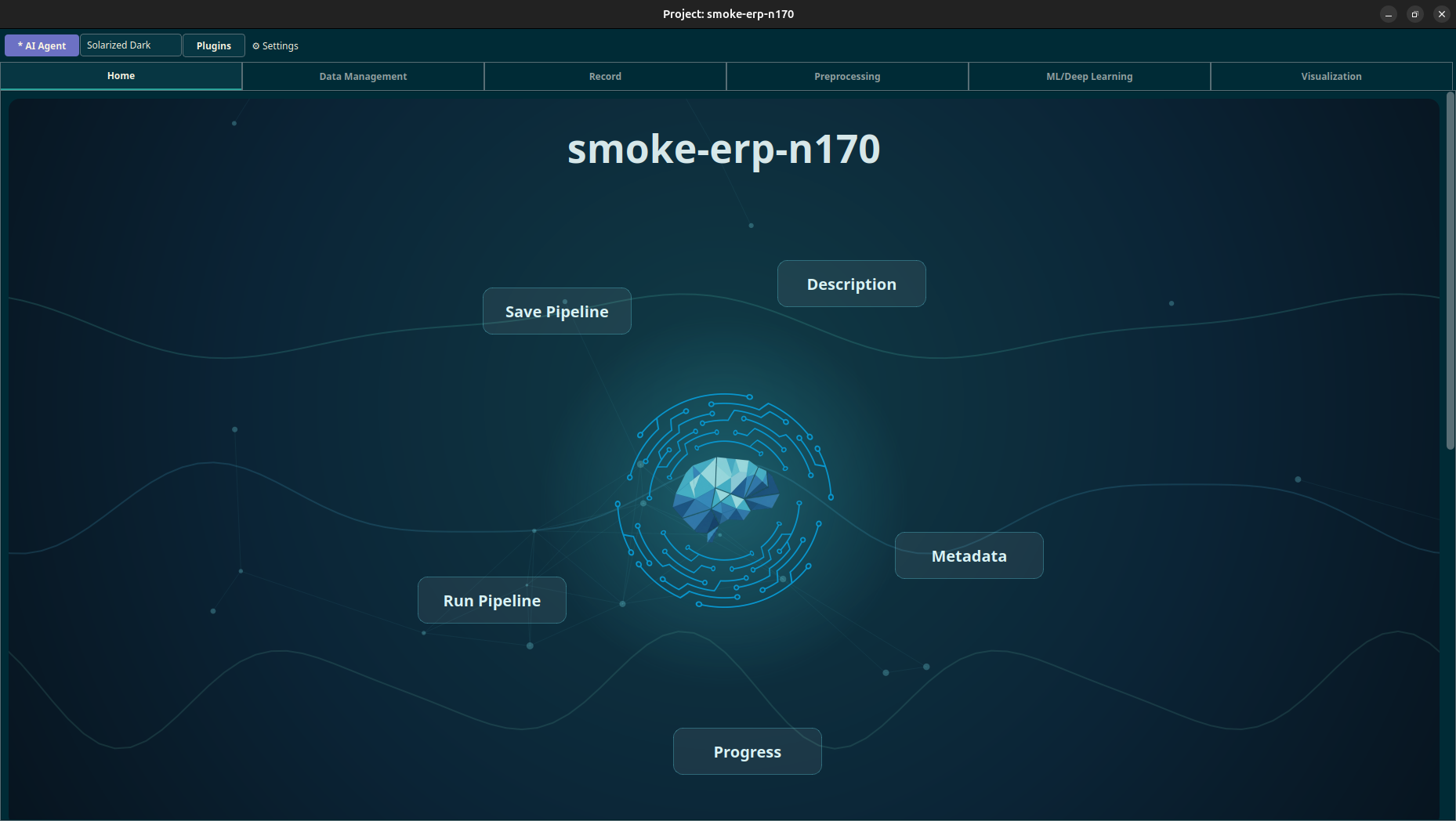 IMG.01
The core workspace: project area, signal view, pipeline canvas, and the AI-assisted development environment in one place.
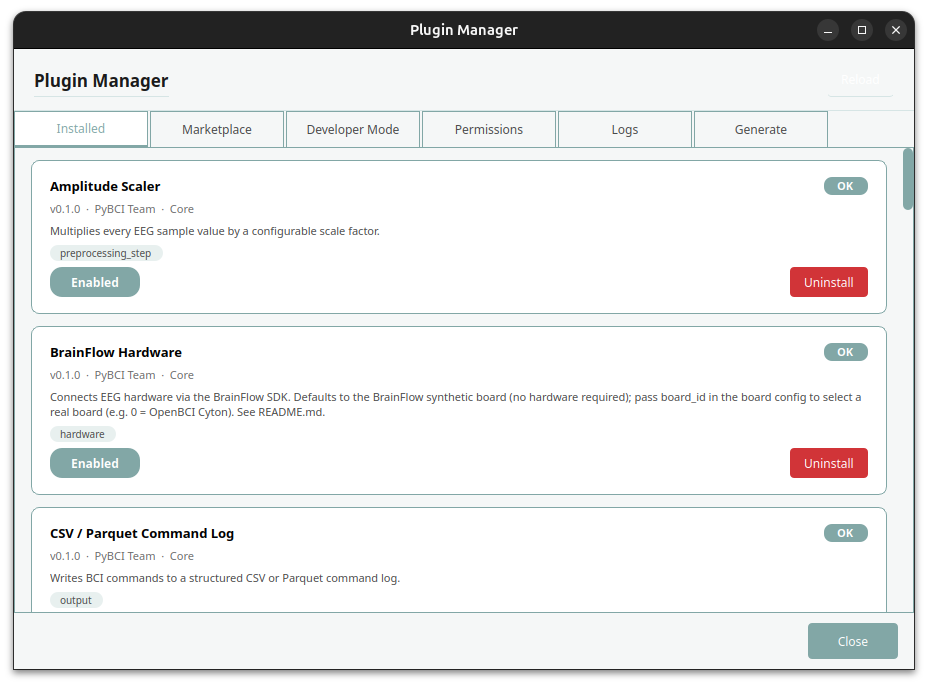 IMG.02
Browse, install, and configure plugins: filters, classifiers, visualizers, exporters, and device connectors.
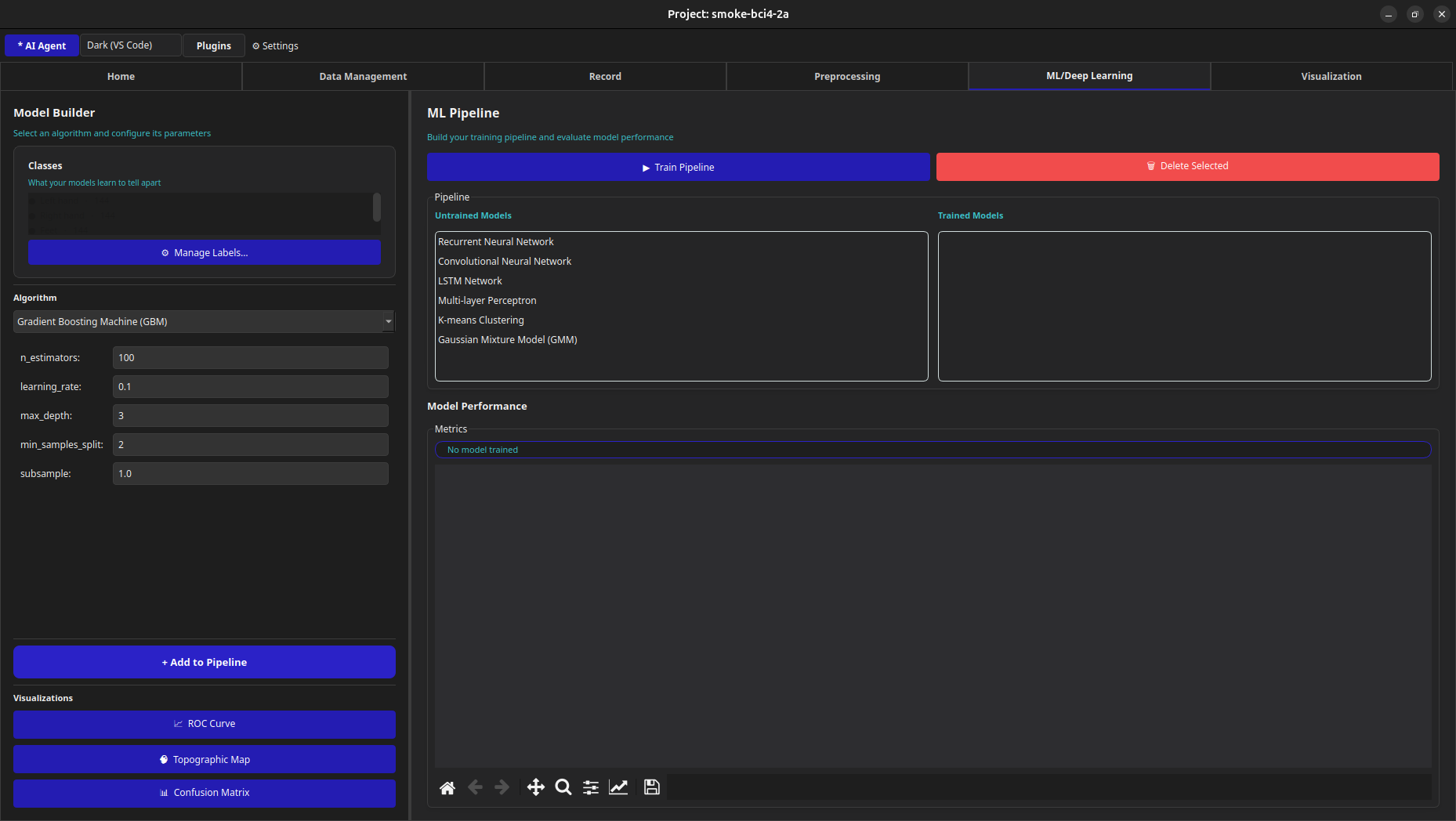 IMG.03
Configure preprocessing, train models, compare results, and operate the workflow through natural language.
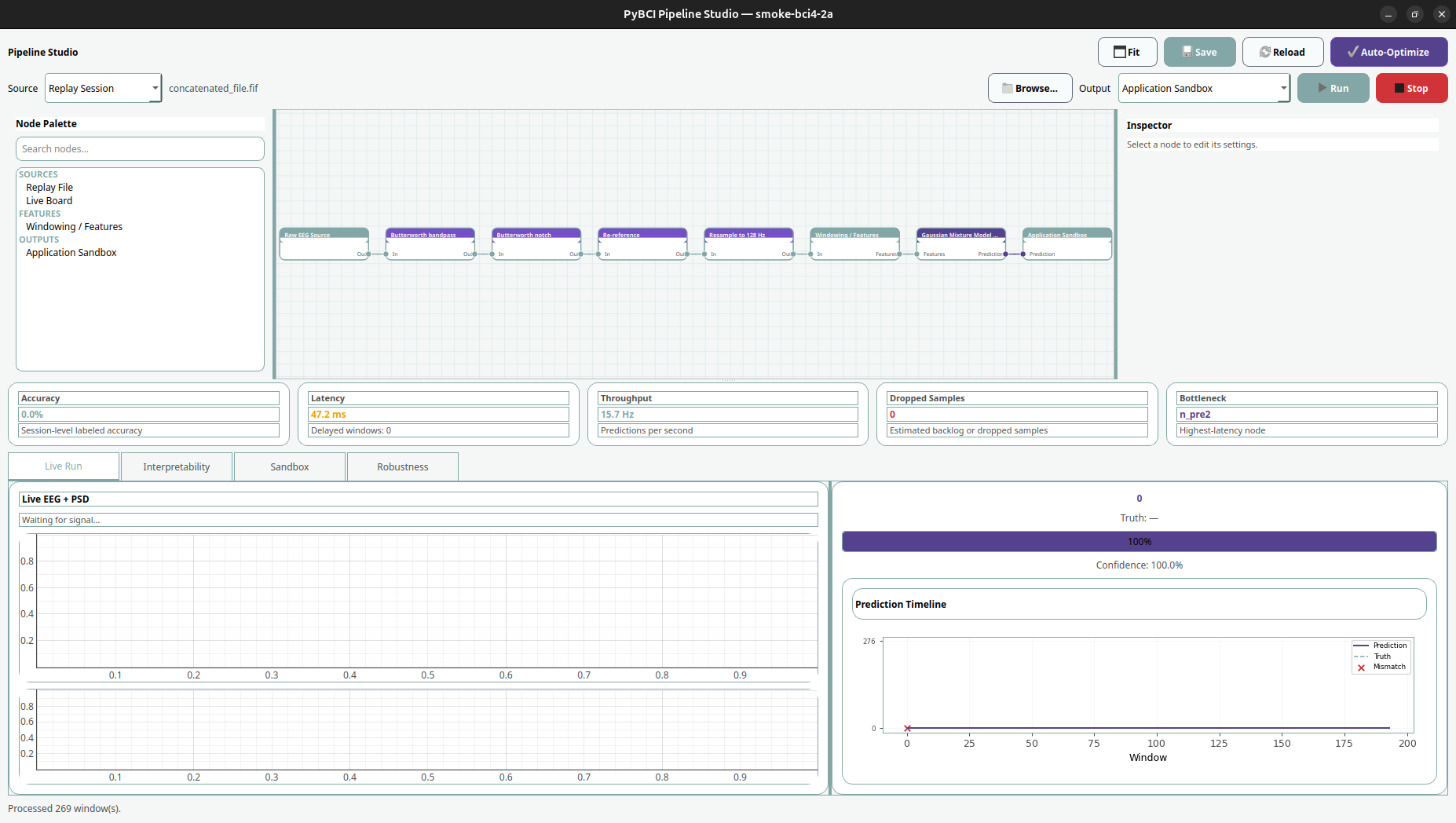 IMG.04
The visual pipeline builder for composing acquisition, preprocessing, modeling, and deployment blocks.
Configure preprocessing, train models, compare results, and explain the workflow state through natural language, keeping the user in control.
Install device connectors, preprocessing blocks, classifiers, visualizers, and deployment tools, or publish your own through the SDK.
Work across EEG headsets, lab amplifiers, and custom acquisition rigs through a modular connector layer.
LDA, SVM, and Random Forests through to CNNs, LSTMs, and attention-based models, with a visual architecture builder.
Build, inspect, and modify acquisition, preprocessing, training, visualization, and deployment stages as reusable workflow blocks.
Standardize pipeline configuration, preserve workflow state, and compare preprocessing and modeling choices without sacrificing traceability.
Connect many kinds of acquisition hardware through adapters instead of locking the workflow to one headset or board.
Drop in filters, feature extractors, classifiers, visualizers, exporters, and deployment tools from a marketplace-style ecosystem.
Compose acquisition, preprocessing, training, visualization, and deployment as swappable workflow blocks.
Let the assistant configure modules, run experiments, compare models, and explain the workflow state.
Send decoded outputs to applications, control systems, robots, or other external targets.
Move from raw EEG to a trained model faster, acquiring, preprocessing, modeling, and visualizing BCI data inside one workflow.
Standardize acquisition, preprocessing, training, visualization, and deployment with reusable workflows across projects.
Prototype neural control systems end to end, connecting hardware, models, and outputs in one modular environment.
Use adapters and plugins to connect acquisition hardware into a complete signal-to-action workflow.
Build and test preprocessing pipelines, model choices, and visualization methods for EEG-based experiments.
Give students and early-stage teams a clearer way to understand the full BCI stack without stitching every tool together.
Prototype systems where neural signals can control digital interfaces, robotic devices, or assistive technologies.
Compare acquisition devices and sensing configurations using a consistent software workflow.
Train, compare, and deploy classical ML and deep-learning approaches for neural data.
Train people to operate a BCI through guided in-app simulations, building the control skills they need before working with live hardware.
A modular environment for researchers, laboratories, neurotechnology teams, and hardware developers building BCI systems — acquisition through deployment, without reconstructing the stack for every experiment.
The bridge between physiological signals and Adaptive Intelligence: the foundation required to develop personalized brain models, closed-loop systems, and future bidirectional interfaces.
Physiological signals are treated as additional context that helps software respond to attention, workload, and intent — not mind reading. Read how physiological context fits the larger vision.
Signed desktop builds for Windows, macOS, and Linux, with install and verification guides.